

Joint Technology Project
technology commercialization and Industry-Academia-Research
Cooperation outcomes through joint technology development


Propulsion Purpose
- Enhancing the technological competitiveness of regional enterprises through CPR (Company & Postech & Regional) demand-customized R&D
- Contributing to enhancing the technological competitiveness of regional SMEs and revitalizing the regional economy through technology transfer and commercialization of university research outcomes (patents, know-how, etc.) to regional companies
- Establishment of a proactive support system for regional enterprises through commercialization R&D support in response to technology transfer demand and full-cycle support for technology commercialization (BM design, feasibility analysis, commercialization R&D)
Program Overview
Program Types for Industry-Academia-Research Joint Technology Development Projects
Type
Scale
Type
Directly assigning projects to research teams capable of performing key research projects in University RISE Specialized Sectors and research tailored to regional demand
zed
Sectors
Semiconductor
Projects /
Multi-year
Projects
Selecting research teams capable of performing creative research projects in Linkage with University RISE Specialized Sectors
- 50 million
Research
Integration
Center Type
Direct support for research projects jointly promoted by universities and research institutes with the purpose of attracting government-funded research institutes to the region
* Participating research teams will be selected through an open call and evaluation process
Projects /
Multi-year
Projects
Specialized Fields
- Electrolyte · separator regeneration technology
- Lithium recovery efficiency enhancement technology
- Optimization of hydrometallurgical · pyrometallurgical processes
- Non-destructive component analysis and diagnostics
- Digital platform for waste battery collection and history management
- Low-temperature eco-friendly decomposition technology
- Automated separation and dismantling of waste batteries
- Second-life battery application technology
- Electrochemical recycling processes
- Hydrogen reduction ironmaking
- Electric Arc Furnace (EAF)-based carbon-free steelmaking processes
- High-efficiency separation and refining of steel scrap
- Development of high-strength lightweight alloys
- Energy-saving technology for high-temperature processes
- Carbon capture, utilization, and storage (CCUS)
- Slag resourcing and recycling
- Smart sensors for carbon footprint tracking
- Smart factory-based process optimization
- Development of corrosion-resistant and high-temperature materials
- Gate-All-Around Transistors
- Next-generation packaging technology
- Development of DRAM/Flash devices based on new materials
- EUV lithography equipment and processes
- Carbon nanotube · graphene-based transistors
- AI semiconductor (NPU, Edge AI) design
- Photonic Semiconductor for Optical Element Integration
- High-frequency power semiconductors
- Quantum semiconductor devices and control technology
- 3D stacking and TSV
- Digital healthcare platforms
- Digital twin-based disease prediction modeling
- Wearable-based biosignal sensor technologies
- Bio-data encryption and privacy protection protection
- Medical imaging AI interpretation technology
- Genomic analysis and diagnostic algorithms
- Smart Drug Delivery System (DDS) devices
- Digital design for mRNA vaccine development
- Digital biobank establishment technologies
- Digital therapeutics
- Solid Oxide Fuel Cells (SOFC)
- Polymer Electrolyte Membrane Fuel Cells (PEMFC) materials
- Efficiency enhancement of water electrolysis devices (Alkaline/PEM)
- Photoelectrochemical (PEC) for green hydrogen production
- High-efficiency hydrogen storage alloys and Liquid Organic Hydrogen Carriers (LOHC)
- Hydrogen leak detection and safety sensors
- Enhancing durability of fuel cell stacks for hydrogen vehicles
- Modular systems for distributed hydrogen power generation
- Hydrogen extraction based on ammonia and methane
Program Operation Process
Designated Type
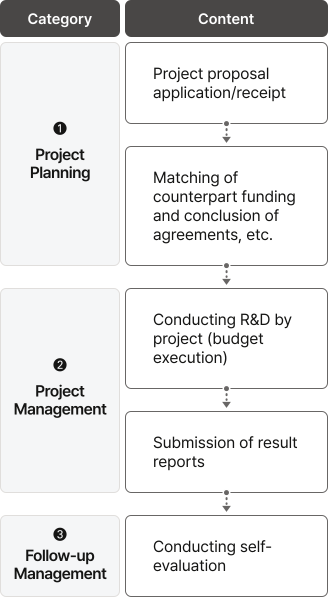
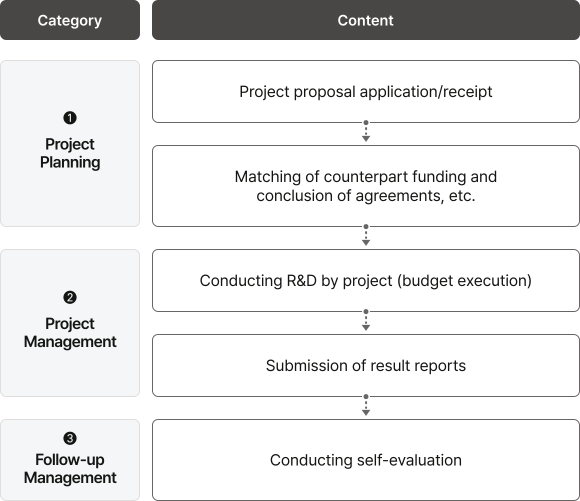
1. Designated Type (지정형)
-
단계 1: Project Planning (과제 기획)
- Project proposal application/receipt (과제 제안서 접수/수령)
- Matching of counterpart funding and conclusion of agreements, etc. (대응 자금 매칭 및 협약 체결 등)
-
단계 2: Project Management (과제 관리)
- Conducting R&D by project (budget execution) (과제별 R&D 수행 및 예산 집행)
- Submission of result reports (성과 보고서 제출)
-
단계 3: Follow-up Management (사후 관리)
- Conducting self-evaluation (자체 평가 수행)
Open Call Type / Academia-Research Integration Center Type
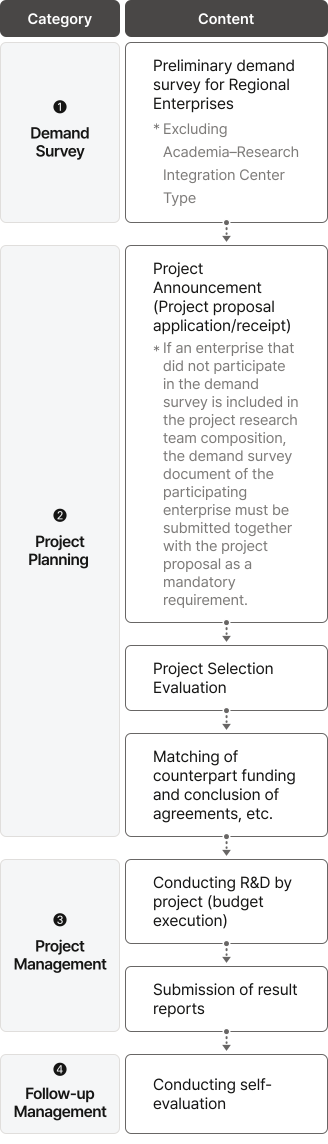
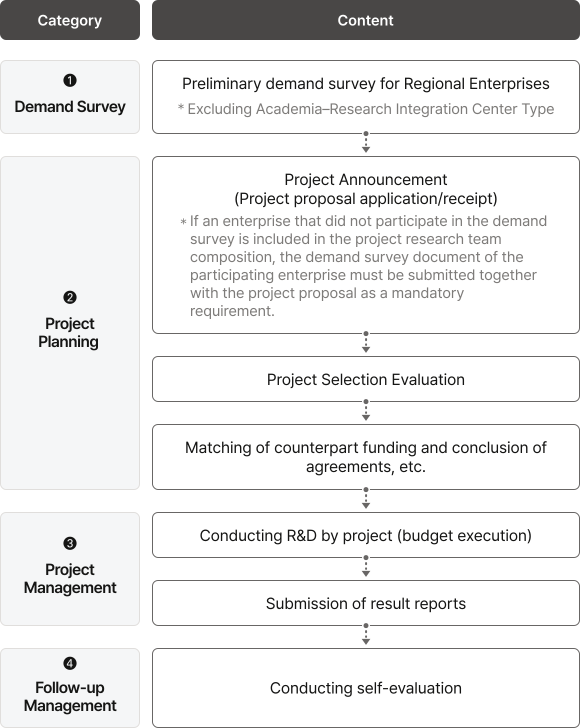
2. Open Call Type / Academia-Research Integration Center Type (공모형 / 학연 융합 센터 유형)
-
단계 1: Demand Survey (수요 조사)
- Preliminary demand survey for Regional Enterprises (* Excluding Academia-Research Integration Center Type) (지역 기업을 위한 사전 수요 조사 * 학연 융합 센터 유형 제외)
-
단계 2: Project Planning (과제 기획)
- Project Announcement (Project proposal application/receipt) (과제 공고 및 과제 제안서 접수/수령)
* 수요 조사에 참여하지 않은 기업이 과제 연구팀 구성에 포함될 경우, 해당 참여 기업의 수요 조사 서류를 과제 제안서와 함께 필수 요건으로 제출해야 함.
- Project Selection Evaluation (과제 선정 평가)
- Matching of counterpart funding and conclusion of agreements, etc. (대응 자금 매칭 및 협약 체결 등)
- Project Announcement (Project proposal application/receipt) (과제 공고 및 과제 제안서 접수/수령)
-
단계 3: Project Management (과제 관리)
- Conducting R&D by project (budget execution) (과제별 R&D 수행 및 예산 집행)
- Submission of result reports (성과 보고서 제출)
-
단계 4: Follow-up Management (사후 관리)
- Conducting self-evaluation (자체 평가 수행)
Project Support Scale
(Varies by Project type, refer to Program types)
(Excluding Academia-Research Integration Center Type)
Operation Content by Project Type
Designated Type
Project Planning
Participation Qualifications
- Research team composition with a faculty member from a RISE-participating department as principal investigator, including participating faculty members·students (graduate student participation encouraged), and researchers from enterprises and other cooperating institutions
- Mandatory inclusion of researchers from enterprises, excluding students, at 20% or more of the total research team
- Principle of participation in one project per faculty member (participation in up to five allowed if expertise is required)
- Only enterprises whose headquarters or research institute is located in Gyeongsangbuk-do (including Daegu) are eligible to participate
- Counterpart funding required for research funds (cash, 10% of national funding)
- Technology transfer commitment and payment of technology transfer fees (20% of government-funded research funds or more) are mandatory
- Faculty-founded enterprises may participate only if the participating faculty member is not the representative, and project composition including other industrial enterprise is mandatory
Performance Creation & Sharing
Projects
- Technology transfer commitment is mandatory
- Payment of technology transfer fees (20% of government-funded research funds or more) before project termination is mandatory
- Submission of research outcome posters at the RISE performance sharing event is mandatory
- Cooperation in participating in the RISE performance sharing event
Projects
- Limited to design rights, trademark rights, utility models, and patent rights
- Limited to SCI(E) and KCI levels
- Technology transfer commitment is mandatory
- Conclusion of technology transfer agreements in the project agreement year and annual payment of technology transfer fees (20% of government-funded research funds or more) are mandatory
- Submission of research outcome posters at the RISE performance sharing event each year is mandatory
- Cooperation in participating in the RISE performance sharing event each year
Open Call Type
Industrial enterprise Demand Survey
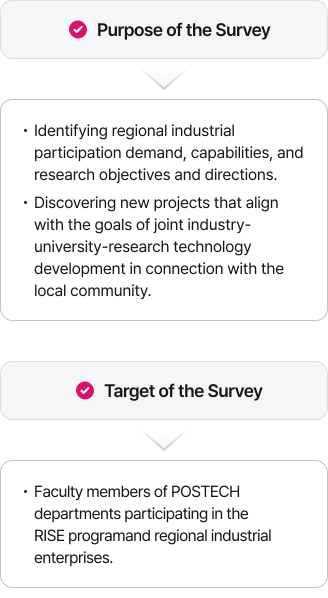

1. Purpose of the Survey (조사 목적)
- Identifying Regional Industrial Participation Demand, Capabilities, And Research Objectives And Directions. (지역 산업 참여 수요, 역량, 연구 목적 및 방향 파악)
- Discovering New Projects That Align With The Goals Of Joint Industry-University-Research Technology Development In Connection With The Local Community. (지역사회와 연계한 산학연 공동 기술 개발 목표에 부합하는 신규 과제 발굴)
2. Target of the Survey (조사 대상)
- Faculty members of POSTECH departments participating in the RISE program and regional industrial enterprises. (RISE 프로그램에 참여하는 포항공과대학교(POSTECH) 학과 교수진 및 지역 산업체)
Survey Items
Information
- Company name, CEO, date of establishment, business registration number, business type/industry, address, website, contact person information, etc.
- Presence of a dedicated R&D department or an affiliated corporate research institute.
- Membership in the "Family Company" program, status as a faculty-founded startup, company size, and relevant technology fields.
- Family company membership, joint industry-academic R&D, technical consulting, shared use of equipment, employee training, industry-academic exchange lectures, Capstone Design, internships, industry-academic consultative meetings, etc.
Development
Survey
- Selection of one area highly relevant to the university's RISE specialized fields.
- Goals and content of technology development, current status of owned technology and R&D trends, status of resources held by the industry, related market trends and size, technology development outcomes, and utilization plans.
- Patent application/registration, publication in domestic/international journals, technology transfer, commercialization, prototype and pilot product development, revenue generation, etc.
- Affiliation, position, and name of the university faculty member(s) wishing to participate jointly.
Eligibility for Participation
- The team must be led by a Principal Investigator (PI) who is a faculty member of a RISE-participating department. The team should include participating faculty, students (graduate student participation is encouraged), and researchers from companies or other partner institutions.
- Researchers from the participating company must account for at least 20% of the total research team (excluding students).
- As a rule, a faculty member may participate in one project as PI (up to five projects are allowed if specialized expertise is required).
- Eligibility is limited to companies whose headquarters or research institutes are located in Gyeongsangbuk-do (including Daegu).
- A matching fund (cash) equivalent to 10% of the government-funded research budget is required.
- Submission of a Letter of Intent for Technology Transfer and payment of Technology Transfer Fees (at least 20% of the government-funded research budget) are mandatory.
- Faculty-founded startups are eligible only if the participating faculty member is not the CEO, and the project team must include at least one other external industrial enterprise.
Outcome Generation and Sharing
- Mandatory commitment to technology transfer.
- Mandatory payment of technology transfer fees (20% of the government-funded budget) before project completion.
- Mandatory submission of a research outcome poster for RISE performance sharing events.
- Cooperation in participating in RISE performance sharing events.
Project Selection
* Candidates who fail to secure research ethics or are under restrictive measures (participation limits) will be disqualified regardless of the evaluation results.
Academic-Industrial Integration Center Type
Eligibility
- Led by a Principal Investigator (PI) who is a faculty member of a RISE-participating department. Composed of participating faculty, students (graduate student participation is encouraged), and researchers from companies or other partner institutions.
- Researchers from the participating research institution must account for at least 20% of the total research team (excluding students).
- As a rule, a faculty member may participate in one project as PI (up to five projects are allowed if specialized expertise is required).
* Pursuant to relevant R&D innovation acts, joint industry-academic technology development projects are excluded from the limit on the number of simultaneous projects.
- Joint corporate participation is allowed.
* Participation of companies with headquarters or research institutes in Gyeongsangbuk-do (including Daegu) is encouraged. Non-local enterprises must describe their regional impact in the project proposal.
Outcome Generation
Multi-year
Projects
(IP)
- Limited to Design, Trademark, Utility Model, and Patent rights.
* Registration/Application must be completed within the total project period.
- Limited to SCI(E) and KCI-level journals.
* Only publications acknowledging RISE support are recognized.
* Must be published within the project period.
- Mandatory submission of a research outcome poster for RISE performance sharing events.
- Cooperation in participating in RISE performance sharing events.
Project Selection
Outcome Management, Utilization and Evaluation
Post-Management (Outcome Management, Utilization, and Evaluation)
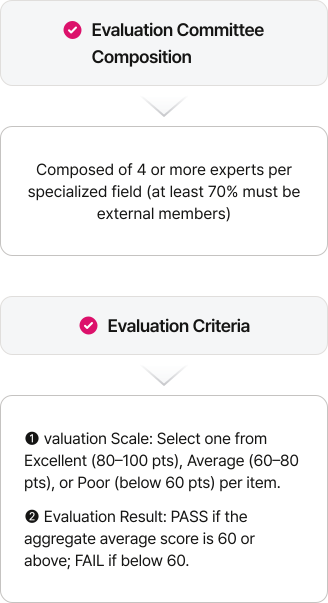

- 평가단 구성
-
- 특화분야별 4인 이상의 전문가(그중 70% 이상은 외부인사)로 구성
- 평가항목
-
- ➊ 평가척도: 항목별 우수(80~100점), 보통(60~80점), 미흡(60점 미만) 中 택 1
- ➋ 평가결과: 평가점수를 취합하여 평균 60점 이상일 경우 PASS, 60점 미만일 경우 FAIL